
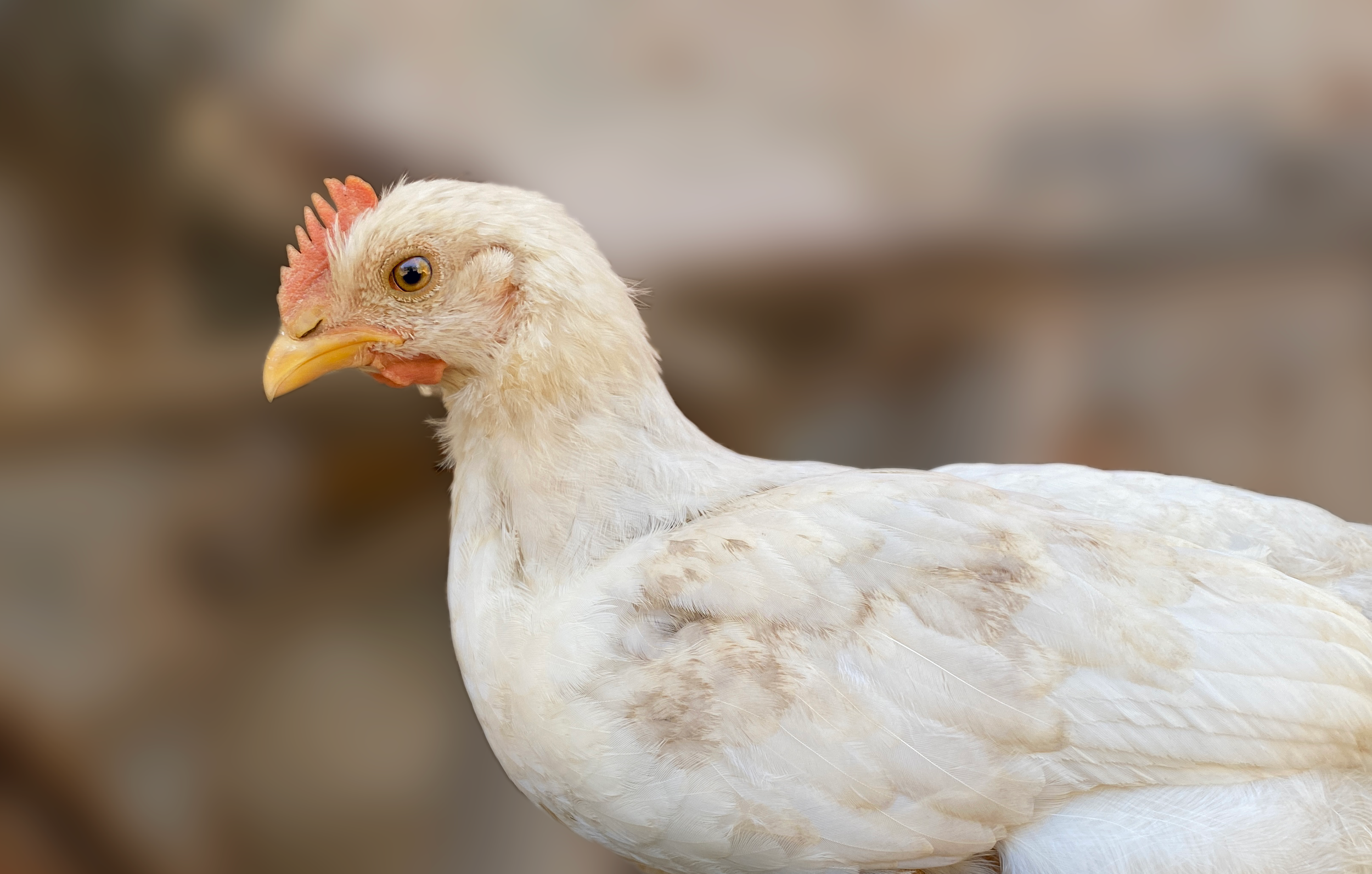
Most chickens slaughtered for food in the U.S. are alive and conscious when they are dumped out of their crates and manually shackled upside down by their legs. This process, known as “live-hang,” is one of the major welfare issues facing chickens in the U.S.
But it doesn’t need to be this way. Controlled atmosphere stunning (CAS) offers a more humane solution for poultry slaughter.
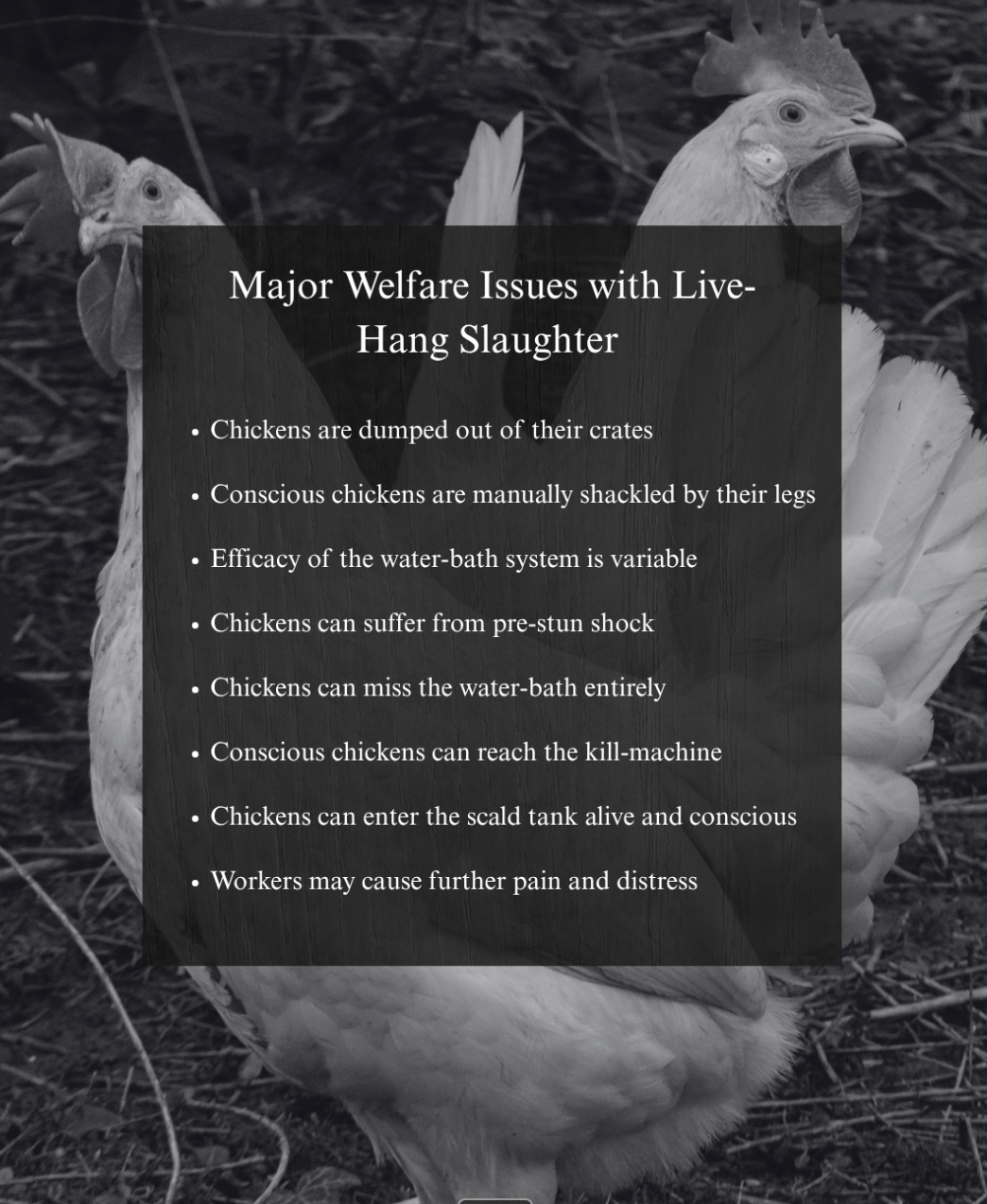
Here’s how live-hang slaughter works: Workers dump panicked, fully conscious chickens out of transport crates. The terrified birds fight to save themselves as workers grab each animal, hoist her into the air, and hang her upside down in shackles on a conveyor belt. The birds bite, scratch, and struggle for safety. Both birds and workers become injured in the process. Meanwhile, the conveyor belt moves the birds forward. The chickens move to an electrified salt-water bath, all while inverted and suspended by their legs. Chickens flap their wings in a futile attempt to right themselves. When a chicken’s head makes contact in the electrified bath, a current passes from the water through the chicken to the leg shackle and ground bar.
The U.S. uses low voltage and high frequency to render chickens unconscious. After being stunned, a throat-slitting machine kills chickens by exsanguination (blood loss). Then, to defeather the chickens, the slaughterhouse submerges the birds in scald tanks. U.S. slaughterhouses typically use “hard” scalding methods, which use temperatures from 131 to 151°F and immersion times of 45 to 120 seconds.
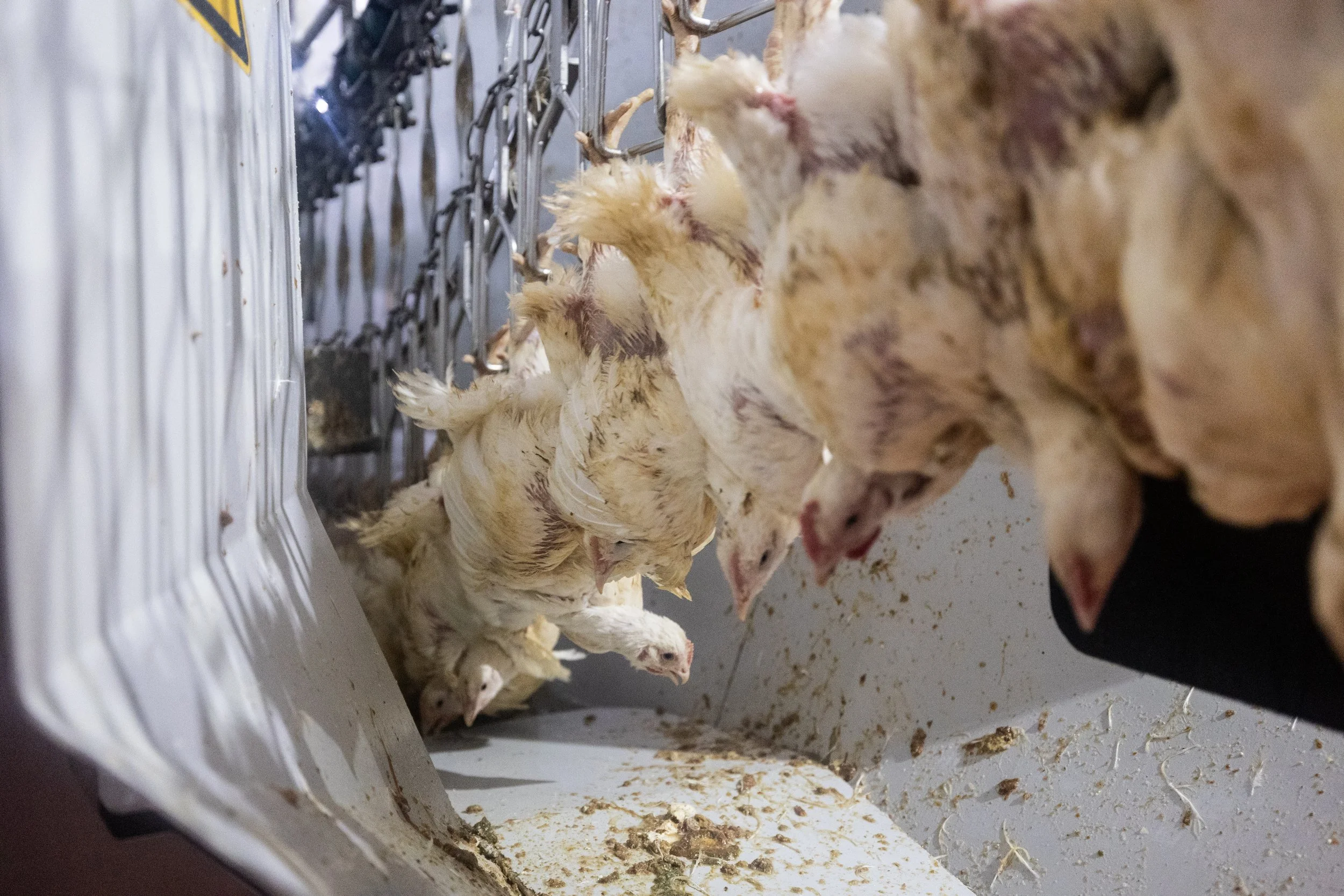
Birds shackled in a live-hang slaughter system. - photo credit WeAnimals Media
The use of live-hang in U.S. slaughterhouses has created an interconnected crisis for both animal and worker welfare. Several aspects of live-hang and electrical stunning result in chickens suffering pain and distress. For instance, physiologic data suggests “it is unclear whether birds truly reach a state of unconsciousness” after being stunned with the low-voltage method, meaning chickens could be conscious, although immobile, when moving through the throat-slitting machine and scald tank.
After being dumped out of their crates, chickens might scramble to the top of the pile and, in the process, sink their claws into other chickens.
Chickens have pain receptors in their legs, which means being shackled causes them pain and distress. Moreover, being upside down is an unnatural posture for poultry who cannot breathe properly upside down; This causes them physiologic stress.
The electric water bath doesn’t consistently or reliably induce unconsciousness. Efficacy is influenced by a number of factors, including the species, gender, body composition and weight, feather condition, proper grounding of the equipment, salinity of the water bath, and the number of empty shackles. Because water-bath systems cannot account for all of these variables, chickens can regain consciousness before being killed or scalded.
Pre-stun shock occurs when a chicken makes premature contact with the water bath, typically with a wing. Upon contact with the water, the current that flows through the chicken induces tonic seizures— “abrupt and vigorous contraction of all body muscles.”
When chickens lift their heads—for example, because of pre-stun shock—they can miss the water bath entirely. Smaller chickens can also miss the water bath because the system is unable to accommodate for different sizes.
Because the U.S. uses such a low voltage for stunning chickens, they can enter the scald tank alive and conscious if their necks are not successfully cut quickly. When a chicken is submerged in the scald tank, the boiling water causes direct trauma and burns the skin of the entire body of the chickens, triggering excruciating pain.
Being slaughtered by throat-slitting while conscious is painful. When chickens miss the water bath—and are thus not stunned—they experience severe and unnecessary pain.
Panicked chickens are difficult for workers to handle, making them vulnerable to humane handling concerns, like bruising and broken bones.
Working along the slaughter line of a live-hang poultry plant is among the most dangerous jobs in the U.S. Between January 2015 and May 2022, an average of twenty-seven poultry slaughterhouse workers per day suffered an amputation or hospitalization. Slaughterhouse workers labor in environments full of life-threatening dangers, from moving machine parts to the tools of the trade, like knives and hooks. The cumulative trauma of repeating the same, forceful motions each day can cause severe, disabling, and chronic injuries. As is the case for chickens, live-hang is often referred to as one of the major welfare issues for slaughterhouse workers.
Live-hang requires workers to grab live and conscious chickens by their feet from one conveyor belt at about waist level, lift the chickens to head level, and hang them upside down by their ankles on another conveyor belt, all in less than 3 seconds per bird, and while chickens scratch and peck at workers’ arms and faces. Many birds defecate and vomit on the workers from above, exposing workers to health risks. The struggling chickens fill the air with dust and mites, which can make the air difficult to breathe and also expose workers to health risks. Moreover, workers are required to do this in near-total darkness because low lighting is believed to help keep chickens calmer. Unsurprisingly, these workers show some of the highest rates of symptoms of trauma disorders, like post-traumatic stress disorder and perpetration-induced traumatic stress, within the slaughterhouse. The physical and psychological impacts are severe.
Why is “live-hang” a common practice in the U.S.? The U.S. Department of Agriculture (USDA) maintains that the Humane Methods of Slaughter Act (HMSA) doesn’t apply to poultry. But the HMSA declares that it is U.S. policy that the slaughtering and handling of livestock shall be carried out only by humane methods. The HMSA requires that “cattle, calves, horses, mules, sheep, swine, and other livestock,” be “rendered insensible to pain . . . before being shackled, hoisted, thrown, cast, or cut.” The HMSA’s language refers to “other livestock.” Chickens fit squarely in the definition of livestock. See Livestock, Black’s Law Dictionary (12th ed. 2024) (defining “livestock” as “[f]arm animals; specif., domestic animals and fowls that (1) are kept for profit or pleasure, (2) can normally be confined within boundaries without seriously impairing their utility, and (3) do not normally intrude on others’ land in such a way as to harm the land or growing crops.” (emphasis added)). If USDA correctly applied the HMSA to chickens, USDA would require chickens to be rendered insensible to pain before being shackled and killed, making “live-hang” as it is currently conducted illegal.
Progressive U.S. slaughterhouses have abandoned “live-hang” and opted for an alternative stunning method—controlled atmospheric stunning. Controlled atmosphere systems have grown in popularity, particularly abroad, because of the animal and worker welfare and product quality advantages. Controlled atmosphere systems induce unconsciousness by exposing chickens to a gas or gas mixture, such as carbon dioxide or nitrogen. The general consensus is that these systems can significantly improve welfare compared to electrical stunning. In addition, systems can reduce aversion by using multiple stages to gradually expose chickens to an increased concentration of the gas or gas mixture.
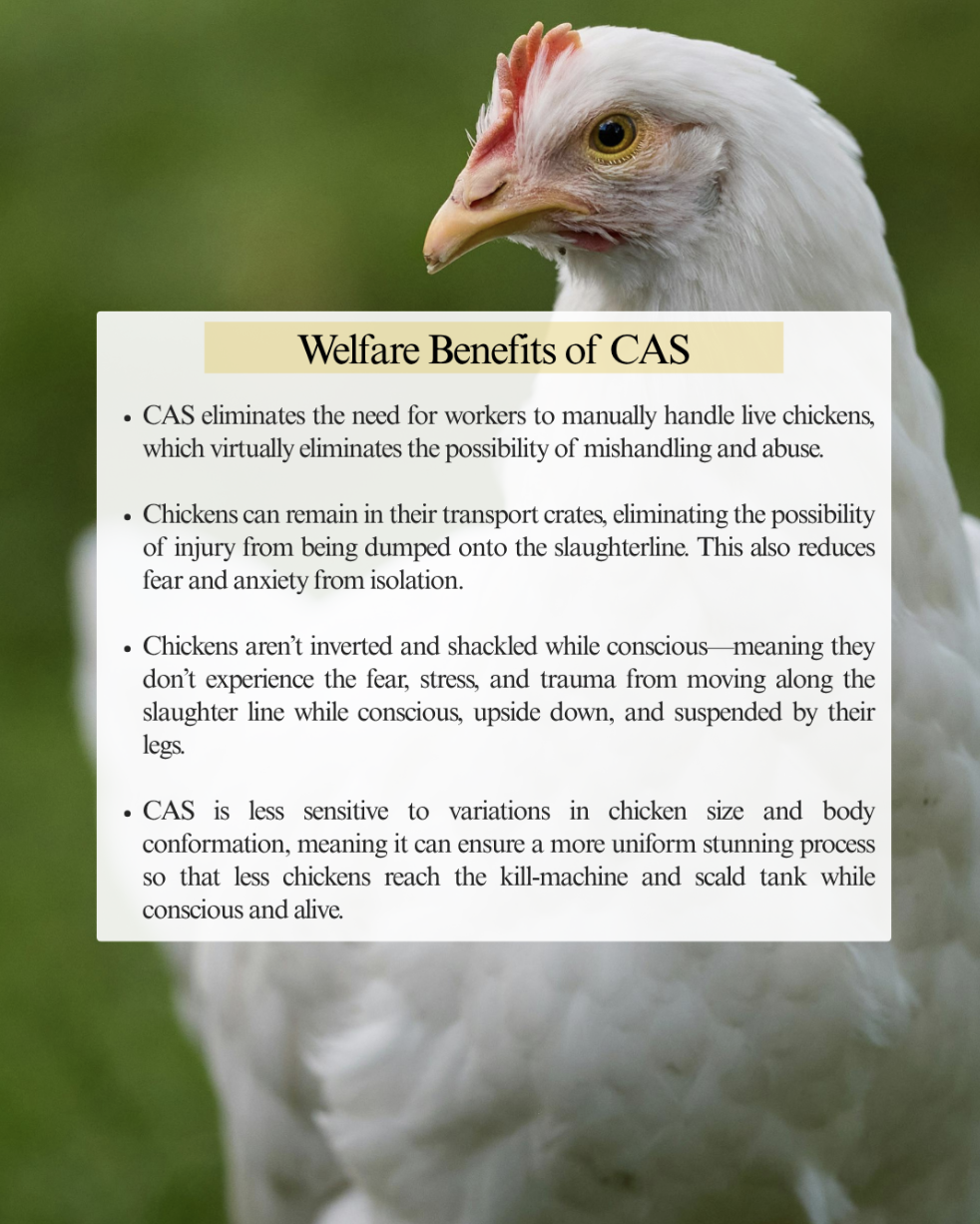
In most controlled atmosphere systems, chickens remain together in their crates while being exposed to a gas or gasses. In practice, because chickens regain consciousness quickly after being exposed to air, most CAS systems are used to kill chickens instead of merely stun them. This means the chickens are unconscious when workers manually unload them from their crates and shackle them.
I
n 2022, the Welfare Footprint Institute published a quantitative assessment of the welfare impacts of multi-stage systems using carbon dioxide compared to electrical stunning. The assessment estimated the level of pain—annoying, hurtful, disabling, and excruciating—for both methods. It concluded that properly implemented multi-stage systems using carbon dioxide can significantly improve welfare: “[T]he expected time endured in intense pain (Excruciating and Disabling) in properly implemented CO2 systems is substantially shorter than in any of the electrical waterbath scenarios simulated, even an ideal waterbath system.” Similarly, the American Veterinary Medical Association’s guidelines for the humane slaughter of animals indicates that controlled atmosphere systems present welfare advantages compared to electrical stunning. Importantly, controlled atmospheric stunning “eliminates the pain, stress, and fear associated with shackling” and “there is a greatly reduced risk of an ineffective stun.”
Compared to electrical stunning, controlled atmosphere systems improve animal and worker welfare by rendering chickens insensible to pain while they’re still in transport crates—which virtually eliminates any pain and distress from manual handling and inversion—creating a calmer and safer slaughtering environment. If you’re a U.S. poultry company or slaughterhouse that uses CAS, a manufacturer of CAS equipment, or an organization that represents poultry slaughter workers, LIC wants to hear from you! Email Ashely Monti at amonti@legalimpactforchickens.org.
Nonprofit Attorney Advertising - Legal Impact for Chickens - 2108 N Street, #5239, Sacramento, CA 95816