
How Long Do Chickens Live? And Six More Chicken Questions
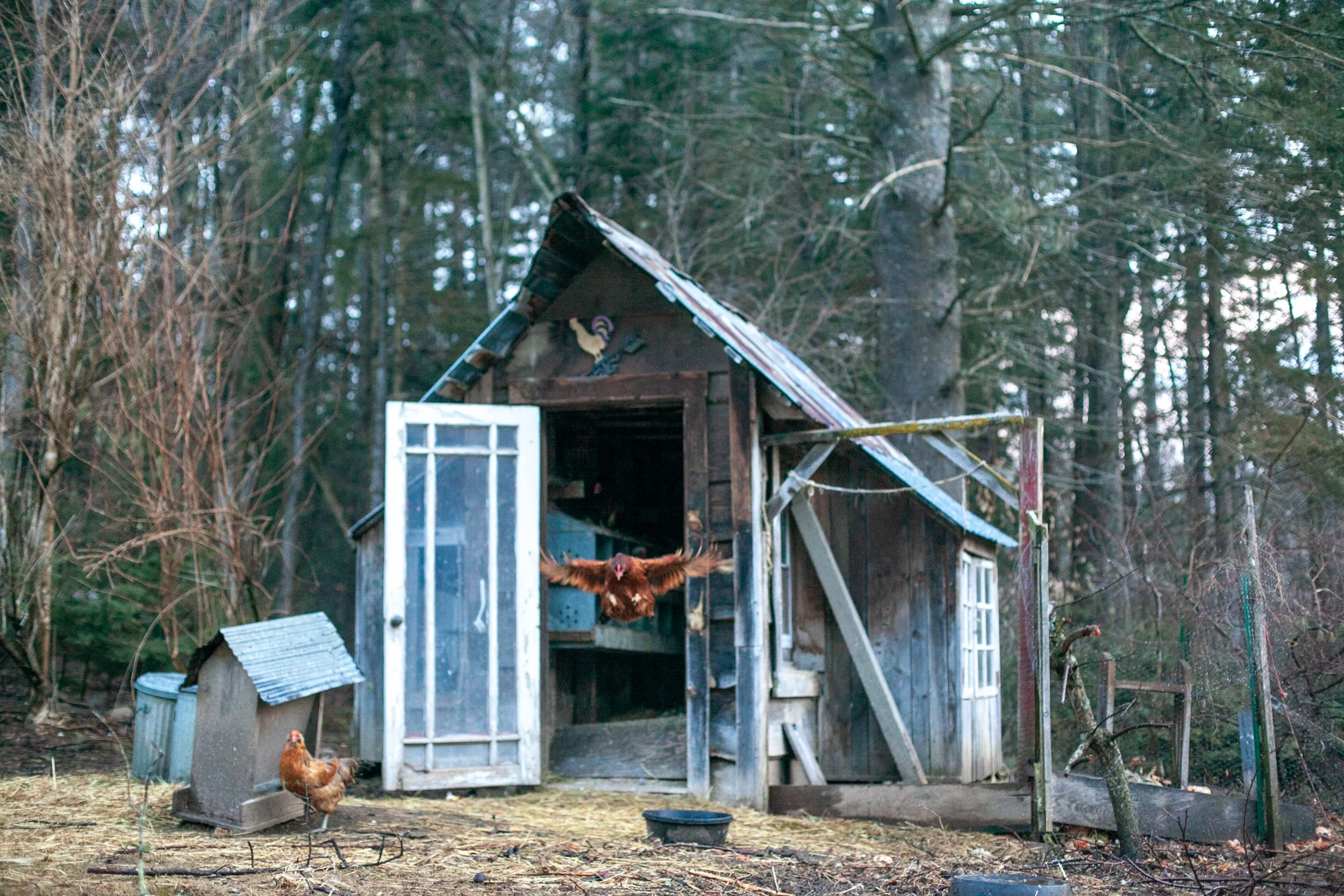
Image by Avi Fox
You have questions. Legal Impact for Chickens has answers.
How long does a chicken live?
A chicken can live about as long as a dog.
Penn State Extension explains: “Chickens in most small flocks live 8 years, but they can live up to 12 to 15 years.”¹
Eight years, give or take, for a bird who gets to grow old. But only a tiny percentage of US chickens get to grow old.
Most chickens raised for meat in the United States don’t live in those small flocks. They live in big, industrial concentrated animal feeding operations (CAFOs), and are killed at just over a month and a half old. The National Chicken Council publishes the number: in 2025, the average market age of a US broiler chicken was 47.5 days.² In other words, these animals are still essentially babies when they go to slaughter.
Hens used for eggs in CAFOs live a little longer, but still don’t get to grow old. Commercial egg flocks get replaced “at or around 72 weeks of age,” according to a review in British Poultry Science—at less than a year-and-a-half old.³ The reason is that birds used for commercial egg production have been bred to lay a huge number of eggs very quickly and regularly (more on that below), but the unnaturally bred birds’ super-fast egg output starts to slip around this age. Large egg companies thus generally consider it more profitable to kill the bird at that point and replace her with a younger hen who will lay at the extreme rate.
So the answer to “how long do chickens live” is multiple very different numbers. A chicken’s natural lifespan is about eight years. But Big Ag only lets its chickens live for a fraction of that.
Can chickens fly?
Yes! Healthy, free chickens can fly. A chicken flies in short bursts—up to a perch, into a tree, over a fence.
Unfortunately, many egg companies force chickens to live in cages so small that the birds can’t even spread their wings or walk—let alone fly. And many chicken-meat companies breed birds to grow so big so fast that the birds become unnaturally large. These fast-growth chickens generally lose the ability to fly while still very young.
But chickens descend from jungle birds who slept in trees, and they’ve kept the instinct. “Chickens have a desire to roost,” as the Cooperative Extension’s poultry guide puts it.⁴ Given the chance, a chicken will fly or hop up to a perch about half an hour before twilight and come down again roughly 30 minutes before dawn.⁴
A chicken’s body is built for trees: “The structure of a chicken’s claws ensures a firm grip while the chicken is perching and will prevent the chicken from falling off a tree branch, even when the bird is asleep.”⁴
Research shows chickens prefer having perches, and giving birds perches is “a way to relieve their stress and to reduce certain injuries and cannibalism.”⁵ Sadly, chickens on US factory farms usually lack any place to perch.
What do chickens eat?
Almost anything. Chickens are omnivores—“that means they can eat plant and animal feedstuffs”⁶—so a hen’s diet runs from grain and greens to insects and worms.
In nature, chickens’ ancestors would find food by foraging. Indeed, wild junglefowl spend 61 percent of their time foraging.⁴
Modern-day chickens retain this instinct to scratch at the ground for food. So, if given the opportunity, even a well-fed chicken will choose to spend time scratching and foraging! Chickens seem to find it fun.
Sadly, however, many egg companies keep birds in small, wire battery cages, where the chickens lack any chance to forage.
How many eggs do chickens lay?
Once again, there are multiple extremely different answers to this question depending on which chickens we’re talking about.
First, of course, only females (hens) lay eggs. The male half of the population (roosters) can’t lay any eggs at all. That’s why the US egg industry generally kills infant male chicks as soon as they hatch: The modern industrial egg industry has bred some chickens for meat (referred to as broilers) and others for eggs (referred to as layers). The genetics of the two groups diverge widely, with one optimized to grow as much muscle as possible as quickly as possible and one optimized to lay as many eggs as possible as quickly as possible. Still, like in most animal populations, roughly half of each group is born female and roughly half born male. Many companies see male chickens who have genetics designed for egg laying as useless.⁷
Second, of course, only adult chickens lay eggs.⁸ Meat companies generally slaughter chickens before the birds get to reach adulthood.² Chickens used for meat—the vast majority of US chickens—thus die before laying a single egg.
So what about adult hens? How often does an adult hen lay eggs? Once again, there are many different answers.
A hen’s wild junglefowl ancestor might have laid about 12 eggs in a year.⁹
But modern domesticated chickens have been subjected to generations of selective breeding. And one of the things that virtually all modern chickens have been bred for is the tendency to lay a lot more eggs than their ancestors. So, if allowed to grow up, even a hen bred for meat (and not for eggs) might lay over 150 eggs per year.
But adult hens bred for eggs specifically (layers) lay even more: Almost 300 a year! USDA writes: “The annual average production per layer on hand in 2025 was 288 eggs.”¹⁰ Laying an egg takes a lot from a bird. It depletes her body of calcium.¹¹ It puts strain on her internal organs. So adult hens bred for eggs often suffer negative health consequences from this intense egg laying, such as bone fractures.¹²
What happens to male chicks?
The US egg industry generally kills infant male chicks as soon as they hatch—since they can’t lay eggs.
That said, some companies, such as Kipster, are switching to a more humane, modern solution: They use in-ovo sexing technology to determine egg sex long before the male chicks hatch. These companies can then destroy eggs containing male embryos, ideally before the chicks are developed enough to feel pain.
What is a group of chickens called?
A flock. And a group of chicks is a brood.
A flock is a society, and the birds in it know one another as individuals. That’s what makes the famous chicken-flock pecking order possible: “In order to develop a pecking order, birds must be able to recognize individuals in a flock.”⁴ Research suggests a laying hen can recognize around 30 individual birds.⁴
Chickens choose each other’s company. They groom together—“Chickens preen on their own, but they prefer to do it as a group activity.”⁴ And they sleep pressed against one another: “Chickens snuggle together during the night and start spreading out about two hours before the lights come on.”⁴
They teach each other, too. When a flock of young hens starts to lay, “the first layers become the teachers for the remaining pullets in a flock.”⁴
Even chicks look after each other. Researchers watching chicks crowd under a heat lamp found that a few chicks lead—and that a leader has been seen leaving the warmth and going “to a chick lagging in the cold so that the chick will follow the leader to the heat source.”⁴
Do chickens have ears?
Yes! You just can’t usually see them.
“Birds have ears on both sides of their heads, and unlike humans, birds do not have external flaps on their ears. Instead, the opening of the ear is covered by a special tuft of feathers. These feathers protect the ear without impairing perception of sound.”¹³
Inside, where a person has three small bones, a chicken has one, called the columella.¹³
And chickens use their ears to listen to one another. Indeed, this starts even before birth. “Chicken embryos generally begin hearing on day 12 of incubation.”¹³ A chick can hear her mother before she hatches. And once hatched, she learns from her: a mother hen makes specific sounds that help her chicks work out which foods are safe.¹³
Chickens have plenty to listen to. They make at least 24 distinct sounds, each fitted to a situation.
---
Legal Impact for Chickens
This post is brought to you by Legal Impact for Chickens (LIC). LIC is a 501(c)(3) charity and society committed to advocating for farmed animals. Please consider giving a tax-deductible gift to support LIC’s work at legalimpactforchickens.org/donate.
---
Sources
¹ Penn State Extension, Successfully Raising a Small Flock of Laying Chickens, https://extension.psu.edu/successfully-raising-a-small-flock-of-laying-chickens.
² National Chicken Council, U.S. Broiler Performance, https://www.nationalchickencouncil.org/about-the-industry/statistics/u-s-broiler-performance/ (market age, market weight, and feed conversion by year, 1925–2025).
³ M.M. Bain, Y. Nys & I.C. Dunn, Increasing persistency in lay and stabilising egg quality in longer laying cycles. What are the challenges?, 57 British Poultry Science 330 (2016), https://doi.org/10.1080/00071668.2016.1161727.
⁴ Jacquie Jacob, University of Kentucky, Normal Behaviors of Chickens in Small and Backyard Poultry Flocks, Cooperative Extension, https://poultry.extension.org/articles/poultry-behavior/normal-behaviors-of-chickens-in-small-and-backyard-poultry-flocks/.
⁵ Perches in Housing for Small and Backyard Poultry Flocks, Cooperative Extension, https://poultry.extension.org/articles/getting-started-with-small-and-backyard-poultry/housing-for-small-and-backyard-poultry-flocks/perches-in-housing-for-small-and-backyard-poultry-flocks/.
⁶ Jacquie Jacob, University of Kentucky, What Does a Chicken Eat?, Cooperative Extension, https://poultry.extension.org/articles/poultry-related-youth-programs/what-does-a-chicken-eat/.
⁷ M.-E. Krautwald-Junghanns et al., Current approaches to avoid the culling of day-old male chicks in the layer industry, with special reference to spectroscopic methods, 97 Poultry Science 749 (2018), https://doi.org/10.3382/ps/pex389 (“As a result, day-old male chicks are culled in the layer hatchery, which poses animal welfare and ethical problems.”).
⁸ Penn State Extension, Management Requirements for Laying Flocks, https://extension.psu.edu/management-requirements-for-laying-flocks (“pullets should come into production at around 20 weeks of age”).
⁹ S. Petow, W. Bessei & L. Schrader, Contrafreeloading and foraging-related behavior in hens differing in laying performance and phylogenetic origin, 102 Poultry Science 102489 (2023), https://doi.org/10.1016/j.psj.2023.102489 (“The ancestor of domestic fowl, the junglefowl, lays around 12 eggs per yr”).
¹⁰ USDA National Agricultural Statistics Service, Chickens and Eggs 2025 Summary, February 2026, https://www.nass.usda.gov/Publications/Todays_Reports/reports/ckegan26.pdf.
¹¹ S. Jansen et al., Bone Health or Performance? Adaptation Response of Genetically Divergent Chicken Layer Lines to a Nutritive Calcium Depletion, 10 Animals 1645 (2020), https://doi.org/10.3390/ani10091645 (“Selection for high egg production in laying hens has led to an increased calcium requirement and consequently to an intensified calcium mobilization from the bones.”).
¹² I.C.N. Thøfner, J. Dahl & J.P. Christensen, Keel bone fractures in Danish laying hens: Prevalence and risk factors, 16 PLOS ONE e0256105 (2021), https://doi.org/10.1371/journal.pone.0256105 (“Depending on the housing system, fracture prevalences exceeding 80% have been reported from different countries.”).
¹³ Jacquie Jacob, University of Kentucky, How Well Can Poultry Hear?, Cooperative Extension, https://poultry.extension.org/articles/poultry-anatomy/how-well-can-poultry-hear/.
~
Thank you for reading a post on the LIC Blog! Views expressed in these blog posts are those of their authors and do not necessarily reflect the view of Legal Impact for Chickens.
